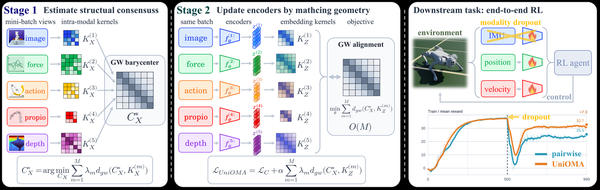
UniOMA uses Gromov–Wasserstein optimal transport to align the structure of heterogeneous robot sensors (vision, force, tactile, IMU, proprioception) into a shared representation space, scaling linearly to three or more modalities and improving robustness to sensor dropout. Contrastive objectives such as InfoNCE align modalities at the instance level but cannot preserve intra-modal geometry — a structural alignment gap that UniOMA closes with a learned Gromov–Wasserstein barycenter regularizer.
@inproceedings{zu2026unioma,title={UniOMA: Unified Optimal-Transport Multi-Modal Structural Alignment for Robot Perception},author={Zu, Xinrui and Luck, Kevin Sebastian and Yu, Shujian},booktitle={IEEE ICRA 2026 Workshop ``From Data to Decisions'' (also Late-Breaking Results)},year={2026},}
2024
MIDL’24
cHeartFlow: Synthesizing Cardiac MR Images from Sketches
Xinrui Zu and Qian Tao
In Medical Imaging with Deep Learning (MIDL), 2024
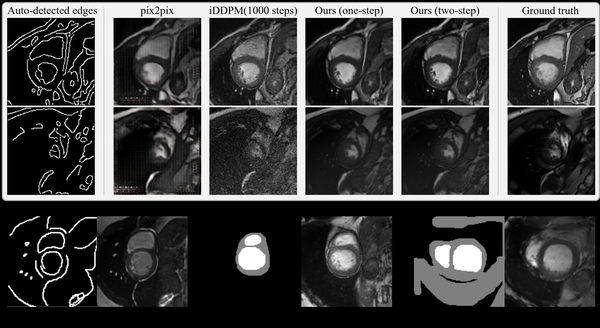
A contrastive generative framework that synthesizes cardiac magnetic resonance (CMR) images from simple sketches by training on contrastive pairs of images and sketches, enabling controllable medical image synthesis and zero-shot registration.
@inproceedings{zu2024cheartflow,title={cHeartFlow: Synthesizing Cardiac MR Images from Sketches},author={Zu, Xinrui and Tao, Qian},booktitle={Medical Imaging with Deep Learning (MIDL)},year={2024},}
2022
ICML’22
SpaceMAP: Visualizing High-Dimensional Data by Space Expansion
Xinrui Zu and Qian Tao
In International Conference on Machine Learning (ICML), 2022
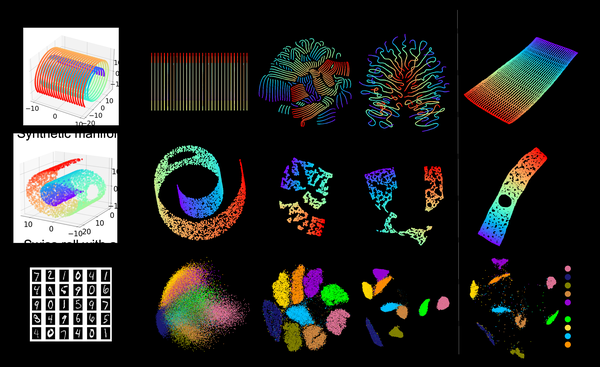
A dimensionality-reduction method that visualizes data of any dimensionality on a 2-D map. We analytically derive a transformation of distance between high- and low-dimensional spaces to match their capacity, and show it provably reduces the intrinsic dimension of high-dimensional data within the maximum-likelihood intrinsic-dimensionality framework.
@inproceedings{zu2022spacemap,title={SpaceMAP: Visualizing High-Dimensional Data by Space Expansion},author={Zu, Xinrui and Tao, Qian},booktitle={International Conference on Machine Learning (ICML)},year={2022},}
TVCG’22
Deep Recursive Embedding for High-Dimensional Data
Zixia Zhou, Xinrui Zu, Yuanyuan Wang, and 2 more authors
IEEE Transactions on Visualization and Computer Graphics (TVCG), 2022
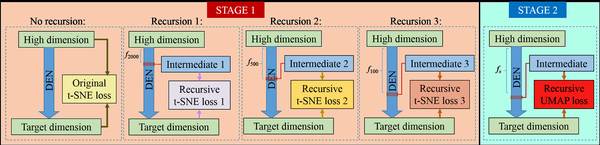
Deep Recursive Embedding (DRE) is a dimensionality-reduction method that leverages latent data representations for boosted embedding performance, maps out-of-sample data, and scales to extremely large datasets, improving both local and global structure preservation over the state of the art.
@article{zhou2022dre,title={Deep Recursive Embedding for High-Dimensional Data},author={Zhou, Zixia and Zu, Xinrui and Wang, Yuanyuan and Lelieveldt, Boudewijn P. F. and Tao, Qian},journal={IEEE Transactions on Visualization and Computer Graphics (TVCG)},year={2022},}
SCMR’22
AI Analysis for Low-Field CMR: A Head-to-Head Comparison of Cine MRI at 0.35T, 1.5T, and 3.0T
Xinrui Zu, Juliet Varghese, Orlando Simonetti, and 1 more author
In Society for Cardiovascular Magnetic Resonance (SCMR) Scientific Sessions, 2022